

Homework 6
- Due: See homework page
Updates
- 2026/04/10 - Written portion is released.
- 2026/04/22 - Coding portion is released.
Written Portion
Problem 1 - Counting (35%)
Note: You should work through all of the problems below by hand, writing out scratch works and supporting steps to SOLVE the problem. However, Gradescope will have a mixture of multiple choice questions and open-ended problems that require you to submit a PDF or image of your works/steps and final answer. To then enter your answers on Gradescope, some problems are:
- Multiple choice. You will only be graded on your correct answer and no work needs to be uploaded though you should have shown work for your own benefit and to prepare for the exam. There will be no partial credit given for wrong answers.
- Other problems will require a PDF upload of your work and we will grade these visually, with the potential for some partial credit. Show your work in such a way that allows the grader to recognize that you understand the relevant lecture material and, when applicable, use the approach/algorithms described in lecture.
See Gradescope for more detail.
1. Consider a 5-character string made up of lower-case, alpha characters, a-z. It is known that the second and third letters are e and a, respectively, (e.g. -ea--) and that the letters s and t appear somewhere in the remaining locations. How many possible such (unique) strings exist?
2. Alice, Bob, and Carlos enter an elevator on the first floor in a six-story building and start going up. Any one of them can exit on any floor from 2nd to 6th, except we know that Alice definitely won’t exit the elevator on the 3rd floor. How many different events can happen? Two events are different if at least one of the three people ends up on a different floor, but if several people exit on the same floor, it does not matter in what order they do it.
3. Consider that one way to categorize Pokemon cards is into water type, fire type, and all other types.
-
3.1. You have a total 21 Pokemons, out of which 7 are water type and 5 are fire type. How many combinations of 3 Pokemon cards (the order they are selected does not matter) exist such that a selection has neither two or more fire types NOR two or more water types.
-
3.2. Your friend sends you 10 random Pokemon cards. How many different combinations exist of their types: water, fire, and other?
4. In how many ways can 4 identical copiers be used to make 6 additional copies of a document (i.e. assuming we have an original for each copier). However, the most copies any single copier can make is 5.
5. There is a Binary Search Tree with 13 nodes. Each node has a distinct value between 0 and 12. The root has value 8, and its left child has value 5. How many possible Binary Search Trees could this be? Tip: Try to define how many ways there are to form a BST of 2 nodes. Then try to define how many ways there are to form a BST of 3 nodes (think about the possible insertion order based on rank: smallest, medium, largest) in terms of 2 node trees for certain cases. Continue to do this for 4 node trees (in terms of 3- and 2-node trees for various cases of insertion ordering based on rank) and 5 node trees.
Problem 2 - Probability (35%)
Note: You should work through all of the problems below by hand, writing out scratch works and supporting steps to SOLVE the problem. However, Gradescope will have a mixture of multiple choice questions and open-ended problems that require you to submit a PDF or image of your works/steps and final answer. To then enter your answers on Gradescope, some problems are:
- Multiple choice. You will only be graded on your correct answer and no work needs to be uploaded though you should have shown work for your own benefit and to prepare for the exam. There will be no partial credit given for wrong answers.
- Other problems will require a PDF upload of your work and we will grade these visually, with the potential for some partial credit. Show your work in such a way that allows the grader to recognize that you understand the relevant lecture material and, when applicable, use the approach/algorithms described in lecture.
See Gradescope for more detail.
1 Suppose a college application asks students to choose, in order, 3 of the following words that best describe them: leader, innovative, determined, logical, empathetic, dreamer, analytical. A college admission officer is lazy and decides to admit any student that chooses innovative and analytical as two of the three as long as innovative is before analytical, OR if they choose empathetic and innovative (in any order).
-
1.1 Supposing that applicants are equally likely to choose any 3 of the 7 words, what is the probability that a student will be admitted by this admission officer?
-
1.2 What is the probability that in the first 10 applications the officer reads, exactly 4 students are admitted.
2 Consider 4 sequential flips of a fair coin.
-
2.1. Let A be the event that 2 consecutive flips both yield heads and let B be the event that the first OR last flip yields tails. Prove or disprove that events A and B are independent.
-
2.2. Let X be the random variable of how many pairs of consecutive flips (of the 4 total flips) both yield heads. What is the expected value of X?
3. You are playing a very limited variant of the famous game WORDLE (find out the rules of this game by clicking on the question mark button at this site
In your version of the game the secret answer can be only one of these words:
NASTY
HASTY
BOARD
HOARD
MATHS
The secret word is chosen randomly (uniformly) before you start playing. You can use only words from the list as guesses. The best starting word is the word with the smallest expected number of moves to finish the game under optimal play. You are choosing between NASTY and HASTY for a starting word. What is the expected number of moves for each of them if you play optimally?
4. Lewis and Zax 27.5: A man is accused of robbing a bank. Eyewitnesses testify that the robber was 6 feet tall and had red hair and green eyes; the suspect matches this descirption. Suppose that only 100 of the 100000 residents in the town are men who are 6 feet tall with red hair and green eyes, and assume that one of them robbed the bank.
-
4.1. What is the probability that the suspect is innocent, given that he matches the description?
-
4.2. What is the probability that the suspect would match the description, given that he is innocent?
-
4.3. Suppose the police reviewed images of 1000 potential suspects when investigating the case, and everyone of the 100000 residents were equally likely to appear in this review. What is the probabilty that at least one of the 1000 would match the description?
5. You are an astronomer studying a planetary system of a red dwarf star. Over years of research you’ve discovered that for this type of star the following is true:
- 30% of stars have 2 planets
- 70% of stars have 3 planets
- No star of this type has less than 2 or more than 3 planets.
There are two general types of planets: gas giants and rocky Earth-like planets that are equally abundant, i.e. if any particular planet orbiting around a star has an equal chance of being giant or rocky.
Some exoplanets are very difficult to observe, specifically, modern telescopes have a 100% chance of detecting a giant Jupiter-like planet if it orbits around a star, but only 20% chance of detecting a rocky Earth-like planet.
After careful observation you found two giant exoplanets in the star system. How likely is it that this star has a rocky Earth-sized planet orbiting it?
Problem 3 - Number Thoery (30%)
Note: You should work through all of the problems below by hand, writing out scratch works and supporting steps to SOLVE the problem. However, Gradescope will have a mixture of multiple choice questions and open-ended problems that require you to submit a PDF or image of your works/steps and final answer. To then enter your answers on Gradescope, some problems are:
- Multiple choice. You will only be graded on your correct answer and no work needs to be uploaded though you should have shown work for your own benefit and to prepare for the exam. There will be no partial credit given for wrong answers.
- Other problems will require a PDF upload of your work and we will grade these visually, with the potential for some partial credit. Show your work in such a way that allows the grader to recognize that you understand the relevant lecture material and, when applicable, use the approach/algorithms described in lecture.
See Gradescope for more detail.
- Use the recursive pattern \(x_{n+1} = (a * x_n + c) \mod m\) to generate the first 5 pseudorandom numbers \(x_1,x_2,...,x_5\) in the sequence given \(a=13, c=7, x_0 = -5, m = 12\)
- How many zeros are at the end of \(100!\)
- Prove that for any integer \(n\), \(n^{5}-5n^{3}+4n\) is divisible by 5.
- Compute \(1333^{42} \mod{11}\).
- Two integers \(x,y \in \mathbb{Z}\) are said to be relatively prime if their greatest common divisor is 1. Use (and show the steps to) the Euclidean algorithm to determine if 309 and 112 are relatively prime.
- Solve \(54*x + 16*y = gcd(54,16)\). Show your work in such a way that allows the grader to recognize that you understand the relevant lecture material.
- Find the multiplicative inverse of \(x = 33 \mod{112}\)
Coding Portion
Github Classroom URL
Signup link to create your HW5 repo: signup link
Reminder: A Few Notes on Repositories
-
Never clone one repo into another. Clone your new homework repo under (in) the
cs104-repos. - Clone your repo using the
sshapproach, NOThttps.- Clone your repo:
git clone git@github.com:usc-csci104-spring2026/<your_hw6_repo>
- In the VS Code editor, choose
File..Open Folderand then find and open that folder (i.e.cs104-repos/<your_hw6_repo>)
Problem 4 - Complete the Course Evalutions (0%)
Take a moment and complete the course evaluations. They should be available via Blackboard. Go to the home page (not for our course but for all of Blackboard) and find the tab in the upper left labelled “Course Evaluations”. Your feedback is appreciated and helps make the class better. If there is constructive or negative feedback, consider describing an alternative approach (solution) to the problem. Thanks!
Problem 5 - Write Your Own String Hash Function (35%)
In this problem you will write your own hash function for std::string in the provided hash.h file. While std::strings can be of arbitrary length and contain any legal ASCII character, we will assume the largest string you will ever receive is 28 letters long (e.g. antidisestablishmentarianism) and only contains letters and digits (‘0’-‘9’). For the letters, you should treat upper-case letters the same as you would lower-case letters.
The Approach
The basic approach will be to treat groups of letters/digits as base-36 and convert to an integer value (i.e. the decimal equivalent).
First translate each letter into a value between 0 and 35, where a=0, b=1, c=2, …., z=25 and digit '0'=26, … '9'=35. Be sure to convert an upper case letter to lower case before performing this mapping. Next you will translate a (sub)string of 6 letters a1 a2 a3 a4 a5 a6 into an (unsigned long long) 64-bit integer w[i] (essentially converting from base-36 to decimal), via the following mathematical formula:
Place zeros in the leading positions if your (sub)string is shorter than 6 letters. So an example string like "104" would set a1, a2, and a3 all to zero (since we only have a length 3 string) and yield \(36^2*27 + 36*26 + 30\) (since '1' : 27, '0' : 26, and '4' : 30) You should use the base conversion approach taught in class to avoid repeated calls to pow(). Note that indexing is a bit tricky here so think carefully. The digit at the “end” of the string is assigned the power 36^0, and the 2nd to last letter is worth 36^1, etc.
If an input word is longer than 6 letters, then you should first do the above process for the last 6 letters in the word, then repeat the process for each previous group of 6 letters. Recall, you will never receive a word longer than 28 characters. The last group may not have 6 letters in which case you would treat it as a substring of less than 6 characters as described above. Since we have at most 28 characters this process should result in a sequence of no more than 5 integers: w[0] w[1] w[2] w[3] w[4], where w[4] was produced by the last 6 letters of the word.
Store these values in an array (of unsigned long long). Place zeros in the leading positions of w[i] if the string does not contain enough characters to make use of those values. So for a string of 12 letters, w[0], w[1], and w[2] would all be 0 and only w[3] and w[4] would be (potentially) non-zero.
We will now hash the string. Use the following formula to produce and return the final hash result using the formula below (where the r values are explained below).
where the \(r[i]\) values are either:
- 5 random numbers created when you instantiate the hash function using the current time as your seed (i.e.
srand(time(0))). Be sure to#include <ctime>and#include <cstdlib>. - 5 preset values for debugging (so we all get the same hash results):
r[0]=983132572, r[1]=1468777056, r[2]=552714139, r[3]=984953261, r[4]=261934300(these numbers were generated by random.org)
Note: We will allow h(k) to produce a large integer (beyond the range of m, the table size) and only mod it by the table size in the hash table (see other programming problem).
The constructor of your hash object will take a debug parameter, which, if true should set the r values to the above debugging values, and if false should select the ranomized values.
Note: Make sure you compute using unsigned long long variables or cast (constants or other variables) to that type at the appropriate places so that you don’t have an overflow error.
Testing
In Spring ‘26 we added a simple website you can use to check your intermediate w[i] values and the final output. It is available here.
We have provided a simple test program, str-hash-test.cpp where you can provide a string on the command line and it will hash the string and output the hash result. Below is some debug output of the w[i] values computed for several test strings using the debug r values.
Below is the output for a few strings:
./str-hash-test abc
yields
w[0] = 0
w[1] = 0
w[2] = 0
w[3] = 0
w[4] = 38
h(abc)=9953503400
./str-hash-test abc123
yields
w[0] = 0
w[1] = 0
w[2] = 0
w[3] = 0
w[4] = 1808957
h(abc123)=473827885525100
./str-hash-test-sol B
yields
w[0] = 0
w[1] = 0
w[2] = 0
w[3] = 0
w[4] = 1
h(B)=261934300
./str-hash-test-sol gfedcba
yields
w[0] = 0
w[1] = 0
w[2] = 0
w[3] = 6
w[4] = 309191940
h(gfedcba)=80987980279261566
./str-hash-test antidisestablishmentarianism
yields
w[0] = 17540
w[1] = 195681115
w[2] = 2203855
w[3] = 732943745
w[4] = 484346964
h(antidisestablishmentarianism)=1137429692708383810
Problem 6 - Hash Table with Double-Hash Probing (65%)
You will create a HashTable data structure that uses open-addressing (i.e. uses probing for collision resolution) and NOT chaining. Your table should support linear and quadratic probing via functors. It should support resizing when the loading factor is above a user-defined threshold. You may use the std::hash<> functor provided with the C++ std library as well as your own hash function for strings made of letters and digits only (no punctuation) that you created in an earlier problem. You should complete the implementation in ht.h.
template<
    typename K,
    typename V,
    typename Prober = LinearProber<K>,
    typename Hash = std::hash<K>,
    typename KEqual = std::equal_to<K> >
class HashTable
{
    /* Implementation */
};
The template types are as follows:
- K: the key type (just like a normal map)
- V: the value type (just like a normal map)
-
Prober: a functor that supports an
init()andnext()function that the hash table can use to generate the probing sequence (e.g. linear, quadratic, double-hashing). A baseProberclass has been written and a derivedLinearProberis nearly complete. You will then write your ownDoubleHashProberclass to implement double-hash probing. The actual Prober type that is passed may contain other template arguments but must at least take the Key type as a template argument. TheDoubleHashProberwill take the key type AND the second hash function type (see below for more details). -
Hash: The primary hash function that converts a value of type K to a
std::size_twhich we have typedef’d asHASH_INDEX_T. -
KEqual: A functor that takes two K type objects and should return
trueif the two objects are equal andfalse, otherwise.
Internally, we will use a hash table of pointers to HashItems (i.e. std::vector<HashItem*> > ). The HashItem has the following members:
typedef std::pair<KeyType, ValueType> ItemType;
struct HashItem {
        ItemType item;  // key, value pair
        bool deleted;
};
You should allocate a HashItem when inserting and free them at an appropriate time based on the description below. If no location is available to insert the item, you should throw std::logic_error, though since we are not using Quadratic probing and we resize the table when the loading factor is above a certain threshold, this should not happen. (Yet we include it in case we do implement quadratic probing in the future.)
We have also provided a constant array of prime sizes that can be used, in turn, when resizing and rehashing is necessary. This sequence is: 11, 23, 47, 97, 197, 397, 797, 1597, 3203, 6421, 12853, 25717, 51437, 102877, 205759, 411527, 823117, 1646237, 3292489, 6584983, 13169977, 26339969, 52679969, 105359969, 210719881, 421439783, 842879579, 1685759167. Thus, when a HashTable is constructed it should start with a size of 11. The client will supply a loading factor, alpha, at construction, and before inserting any new element, you should resize (to the next larger size in the list above) if the current loading factor is at or above the given alpha.
For removal of keys, we will use a deferred strategy of simply marking an item as “deleted” using a bool value. These values should not be considered when calls are made to find or operator[] but should continue to count toward the loading factor until the next resize/rehash. At that point, when you resize, you will only rehash the non-deleted items and (permanently) remove the deleted items.
We will not ask you to implement an iterator for the hash table. So find() will simply return a pointer to the key,value pair if it exists and nullptr if it does not.
To facilitate tracking relevant statistics we will use for performance measurements, we have provided the core probing routine: probe(key). This routine, applies the hash function to get a starting index, then initializes the prober and repeatedly calls next() until it finds the desired key, reaches a hashtable location that contains nullptr (where a new item may be inserted if desired), or reaches its upper limit of calls (i.e. cannot find a null location). probe() utilizes the Prober. Prober::init is called to give the prober all relevant info that it may need, regardless of the probing strategy (i.e. starting index, table size, the key (which would be needed by double-hash probing) etc.). Then a sequence of calls to Prober::next() will ensue. If, for example we are using linear probing, the first call to next() would yield h(k), the subsequent call to next() would yield h(k)+1, the third call would yield h(k)+2, etc. Notice: the first call to next() just returns the h(k) value passed to Prober::init(). As probing progresses we will update statistics such as the total number of probes. Some accessor and mutator functions are provided to access those statistics.
Note: When probing to insert a new key, we could stop on a location marked as deleted and simply overwrite it with the key to be inserted. However, because our design uses the same probe(key) function for all three operations: insert, find, and remove, and certainly for find and remove we would NOT want to stop on a deleted item, but instead keep probing to find the desired key, we will simply take the more inefficient probing approach of not reusing locations marked for deletion when probing for insertion.
A debug function, reportAll is also provided to print out each key value pair. Use this when necessary to help you debug your code.
Probers
We have abstracted the probing sequence so various strategies may be implemented without the hash table implementation being modified. Complete the LinearProber and then write a similar DoubleHashProber that uses double-hashing. Return npos after m calls to next() .
Double Hash Prober
Your double-hash prober should take in two template arguments:
template <typename KeyType, typename Hash2>
struct DoubleHashProber : public Prober<KeyType>
{
  /* Code */
};
The KeyType is the same as that of the hash table, while Hash2 should be a function object that implements a HASH_INDEX_T operator()(const KeyType& key) const. Our double-hash prober should use a stepsize of m2 - h2(k)%m2 where m2 is some prime moduli less than the current hash table size. Since our double hash prober needs this separate m2, we have a static array of moduli to use and provide a helper function to determine which moduli to use, given the hash table size, m passed to init(). The init() is complete but can be appended to, if need be.
Testing Your Hash Table
A simple test driver program ht-test.cpp has been provided which you may modify to test various aspects of your hash table implementation. We will not grade this file so use it as you please. BUT PLEASE do some sanity tests with it BEFORE using any of our test suite.
Problem 7 - Subgraph Isomorphism (OPTIONAL - UNGRADED) (0%)
In this problem, you will again use backtracking search to determine if two graphs are isomorphic. Two graphs, \(G1\) and \(G2\), are said to be isomorphic if:
- There exists a bijection (1-to-1), or mapping \(M\), from the vertices of G1 onto the vertices of G2 where M(v1) => v2 for v1 in G1 and v2 in G2), such that:
- for each edge \((u1,v1)\) in G1, the edge \((M(u1), M(v1))\) exists in G2 AND
- for each vertex, \(v1\) in G1, \(deg(v1) = deg(M(v1))\).
We have written and implemented a basic graph class for you. It reads in graphs (as adjacency lists) from an input stream (file) and allows you to check if an edge exists, find all the neighbors of a given vertex, and get all the vertices in the graph. It uses a std::map to store the graph information in adjancency list form.
// Graph class for use with graph isomorphism function
typedef std::string VERTEX_T;
typedef std::set<VERTEX_T> VERTEX_SET_T;
typedef std::vector<VERTEX_T> VERTEX_LIST_T;
class Graph {
public:
    Graph(std::istream& istr);
    bool edgeExists(const VERTEX_T& u, const VERTEX_T& v) const;
    const VERTEX_SET_T& neighbors(const VERTEX_T& v) const;
    VERTEX_LIST_T vertices() const;
private:
    std::map<std::string, VERTEX_SET_T > adj_;
};
Your task is to write a function (prototyped below) to determine if the two graphs are isomorphic (as defined above) and return true if so, and false, otherwise, AND if you return true you must also provide the valid mapping of vertices in graph 1 and their corresponding mapped vertices in graph 2 that form the isomorphism (i.e. you should produce a map where each key represents a vertex v1 in G1 and its corresponding value represents a vertex, v2, in G2 that v1 maps onto).
To create, update, and store this mapping, you MUST use your hash table data structure from the previous part of this homework. If you do not use your hash table implementation, you will RECEIVE NO CREDIT on this problem.
/// Use your hashtable for the mapping between vertices
typedef HashTable<VERTEX_T, VERTEX_T> VERTEX_ID_MAP_T;

/**
 * @brief Determines if two graphs are isomorphic
 *
 * @param g1 Graph 1
 * @param g2 Graph 2
 * @param mapping isomorphic mapping between vertices of graph 1 (key) and graph 2 (value)
 * @return true If the two graphs are isomorphic
 * @return false Otherwise
 */
bool graphIso(  const Graph& g1,
                const Graph& g2,
                VERTEX_ID_MAP_T& mapping);
Testing
We have provided a “driver”/test program (graphiso-driver.cpp) that will read in two files (whose names are given on the command line) that contain graph descriptions, call your function, and then print the results for you to verify. You can compile it with make and run it as:
./graphiso-driver graph1a.in graph1b.in
Use graphiso-driver to do some sanity tests of your code before moving on to any of the tests from our grading suite.
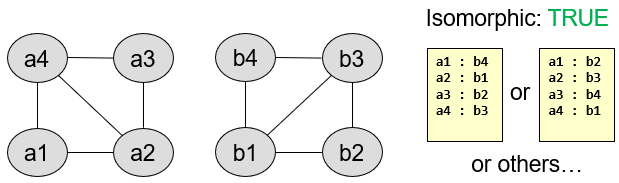
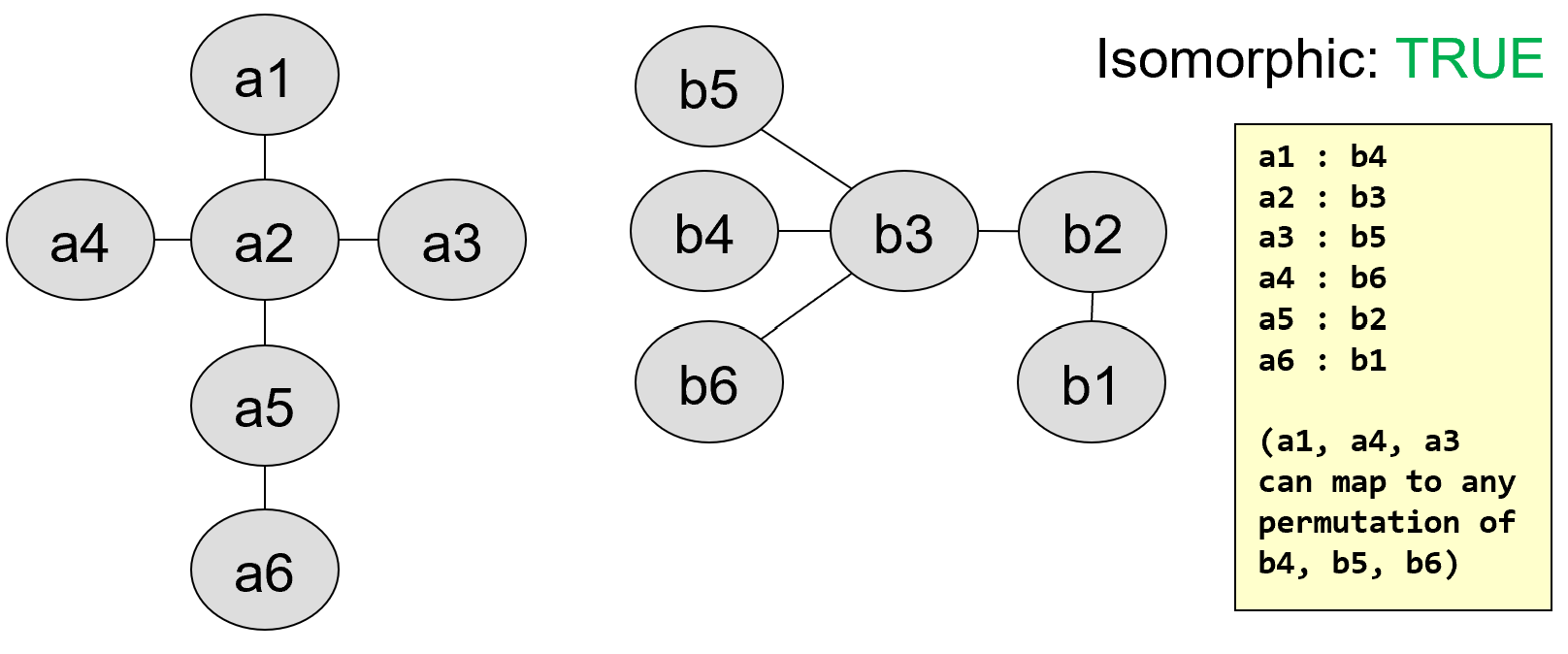
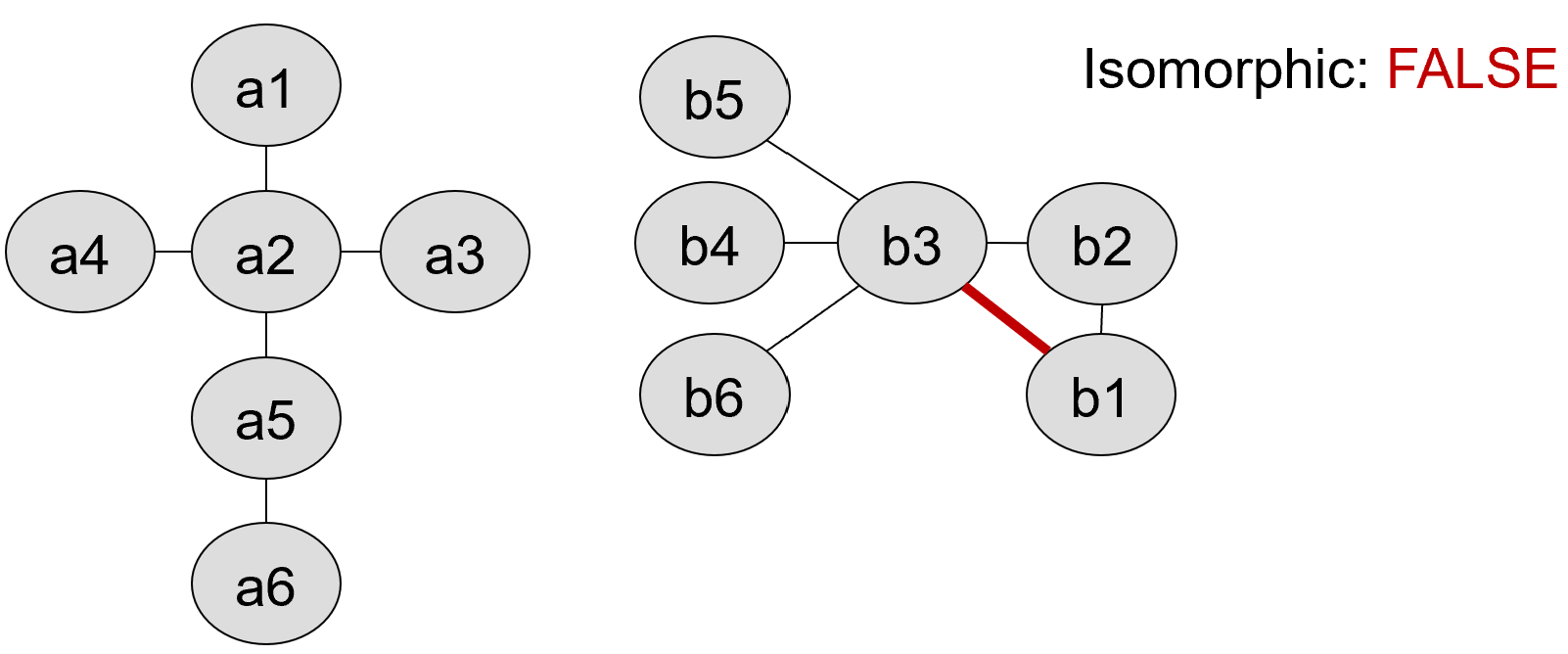
A few examples of graphs and the results that your function should produce are shown below. We have provided three pairs of graphs in the files: graph1a/b.in, graph2a/b.in, and graph3a/b.in that match the examples shown below.
Graph 1a/1b:
Graph 2a/2b:
Graph 3a/3b:
During grading, we will run some additional instructor tests but they will be similar to the ones we provide in our test suite.
Requirements and Assumptions
- As always you may not change the signature of the primary function provided.
- You MAY define helper functions in
graphiso.cpp - You MUST use a recursive approach that follows the general backtracking structure presented in class. Failure to use such a recursive approach will lead to a 0 on this part of the assignment.
- You MAY use structures such as
std::setorstd::maporstd::vectoras necessary to help your implementation. - There is no specific runtime, but you must pass each test in
ctestwith timeout limits of 60 seconds per test. - Any valid mapping is acceptable (since many may exist for certain graphs). Our tests simply verify your solution rather than looking for a hard-coded mapping.
Hints and Approach
Recall that a backtracking search algorithm is a recursive algorithm that is similar to generating all combinations, but skipping the recursion and moving on to another option if the current option violates any of the constraints. It is likely easiest to recurse over each vertex in graph 1 attempting to find a suitable mapping to a vertex in graph 2 that meets the criteria known (or assigned) at the current time. As you map a vertex from G1 to G2, you can check whether the vertices you’ve mapped are “consistent” and meet the isomorphism requirements. Because not all vertices will be mapped during the intermediate stages of your algorithm, you can only determine if a mapping is NOT valid by finding mapped vertices that have differing degrees or if an edge, \((u1, v1)\), in G1 where both \(u1\) and \(v1\) are mapped to a vertex in G2, does NOT have a corresponding edge \((M(u1), M(v1))\) in G2.
We have provided the start of a helper function you can use to implement these checks.
bool isConsistent(const Graph& g1, const Graph& g2, VERTEX_ID_MAP_T& mapping);
You should consider completing it and calling it from your main backtracking code.
Submission Files
-
Add, commit and push your source files including all the
.cppand.hfiles andMakefile. -
Do NOT add/commit/push
.ofiles or executables (things that the compiler can easily generate anytime we need). If you want to avoid adding files you should not, you can add the lines to your.gitignoreand then save, add, commit, push the.gitignore
Do NOT commit/push any test suite folder/files that we provide from the resources repo. When we grade your code, we will move a fresh copy of the hw6_tests folder into your repo, cd to that test folder, and run
cmake .
make grade
WAIT You aren’t done yet. Complete the last section below to ensure you’ve committed all your code.
Commit then Re-clone your Repository
Be sure to add, commit, and push your code in your hw6 directory to your assignment repository. Now double-check what you’ve committed, by following the directions below (failure to do so may result in point deductions):
- In your terminal,
cdto the top level folder (e.g.cs104-repos) that has yourresourcesandhw6-<your_reponame>repos, etc.
cd ~
cd cs104-repos  # or wherever you store your repos
- Create a subfolder called
verifyusing themkdircommand below and thencdinto that folder.
mkdir -p verify
cd verify
- Clone a new copy (of the latest contents that you pushed) of your assignment repo hw_username repo:
git clone git@github.com:usc-csci104-spring2026/hw6-<your_reponame>.git`
cd hw6-<your_reponame>
- Copy the test suite folder again into this new repo copy: `
cp -rf ../../resources/hw6_tests .
- Recompile and rerun your programs and tests to ensure that what you submitted works. You may need to copy over a test-suite folder from the
resourcesrepo, if one was provided.
cd hw6_tests
cmake .
make grade
And ensure all the tests pass (or the ones you expect to pass).
If there is a discrepancy, you likely did not add/commit/push your latest code. Go back to your cs104-repos/hw6-<your_username> repo/folder and figure out what did not get pushed, and rectify the situation.
Then, you can come back to cs104-repos/verify/hw6-<your_username>/hw6_tests and re-run make grade, repeating this process until it gives the expected results.