***
←
→
Notes related to my proof
What follows are explainer notes to clarify the concepts in the proof.
The material is in the form of a slideshow. To navigate, use the arrow keys on your keyboard (or the spacebar to advance; the slides loop around), or the arrow keys at the top-left of each slide. You can press 'a' or the '***' toggle at the top-left again, for 'all' (single page) mode vs slides.
Not every concept is explained in every slide in great detail, that would be repetitive and long - so please do refer back to the proof pdf where necessary. That said, I do go through core concepts in more detail.
Why provide such an exposition/explainer at all? Because it's useful, satisfying, fun, even necessary. Related, Terence Tao has this in his recent (8/17/26) paper related to the timely and important topic of 'AI and math':
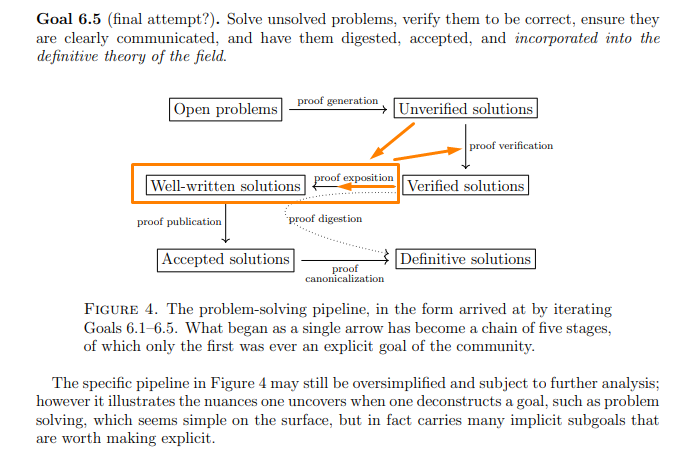
I added the orange arrows to mean this: this presentation might even be useful to those (humans!) who do proof verification.
The Collatz Conjecture
TL;DR: a fascinating problem... quite easy to understand, not easy to solve!
A lot comes up when we do a search.
The conjecture involves picking a positive whole number, then performing one of these two simple steps (depending on whether a number is odd or even) over and over
- if n is odd, do 3n+1 [which makes it even]
- if n is even, do n/2 [which might remain even, or become odd]
Note the asymmetry: 'odd->even' involves just a single step, but 'even->odd' on the other hand could take multiple steps.
All sorts of interesting, amusing, pretty... pics show up in the search :)
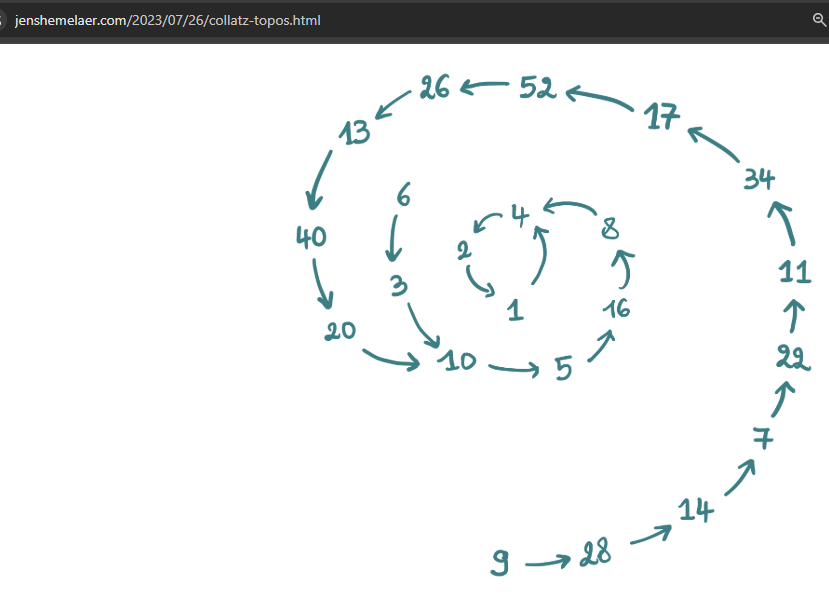
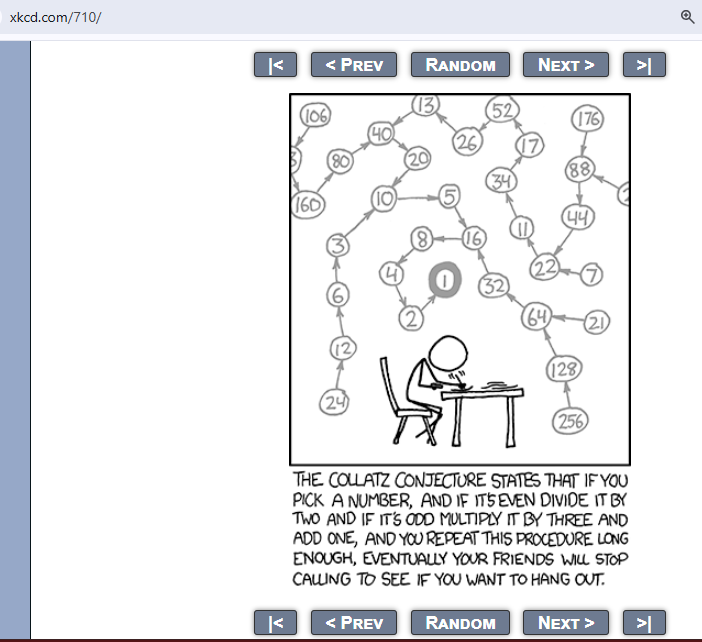
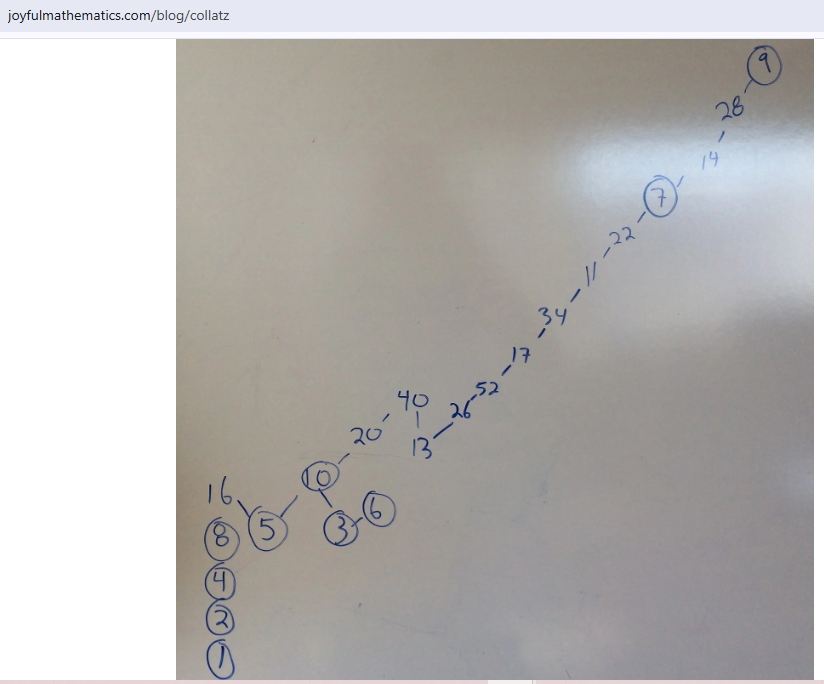
Compared to the numbers near it (eg. 21, 26, 28, 33), 27's sequence works out to be excessively long.
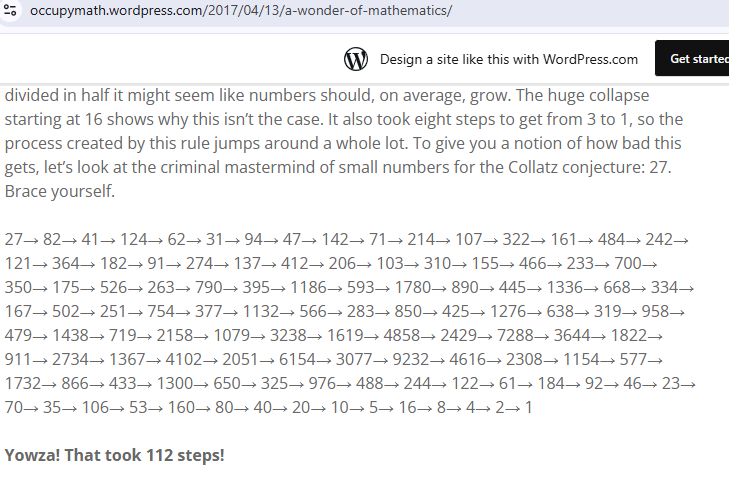
You can put in different numbers here [in the left side where it says 'try it out'], to see what their sequences look like.
So, what's the conjecture? As you noticed, whatever number you start with, the end result is the same: the number's sequence (aka trajectory or orbit, when generated by a scheme like ours) reaches 1 (after which it loops on to itself, ie. 1 -> 4 -> 2 -> 1). Conjecture: EVERY number ('ever') would do likewise, ie. reach 1.
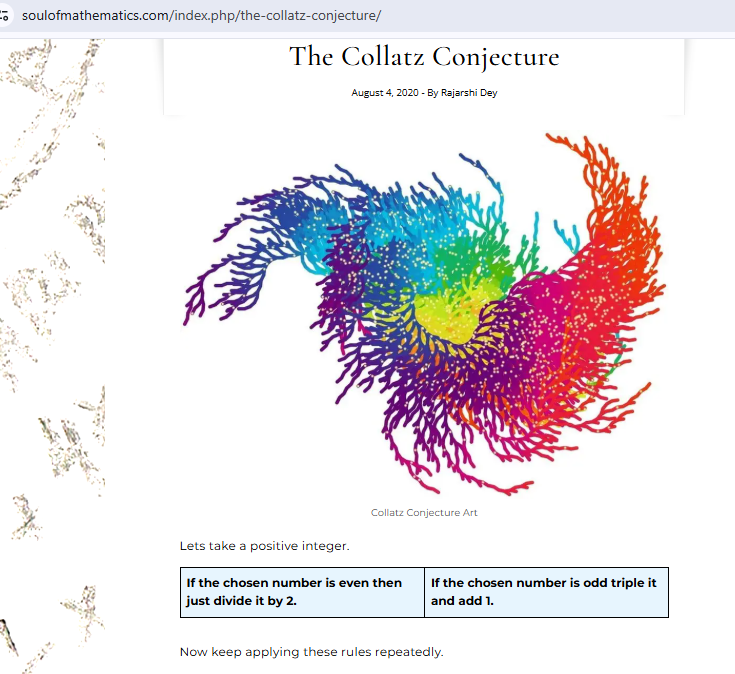
So the game has been, to either:
- prove this to be true for EVERY number [not by manually trying it out for 1,2,3,4,5... one by one!]
- disprove it - with a SINGLE counterexample even, ie. find a number whose sequence doesn't (can't) reach 1
Again note the assymetry - proving this would be much harder than disproving [for which even brute search would work as a strategy].
Why is this hard? Answer: apparent lack of a pattern in the numbers' behavior. Eg. here are the # of steps taken by 1,2,3..100 to reach 1:

TL;DR: yes, there *is* (deeply hidden) ordering!
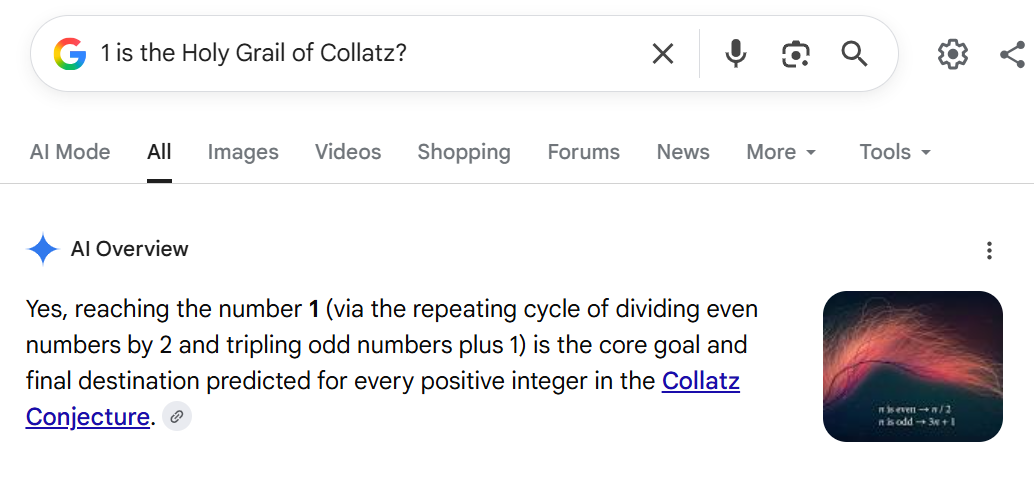
The Holy Grail in Collatz is to find an order/scheme in how numbers transform, which in turn can help prove that they ALL reach 1.
Always a good day when 'AI' agrees, lol:
The ordering I found is revealed, loosely speaking, after separating out N+ = {1,2,3,4,5.... inf} using 5 'sieves' in order :)
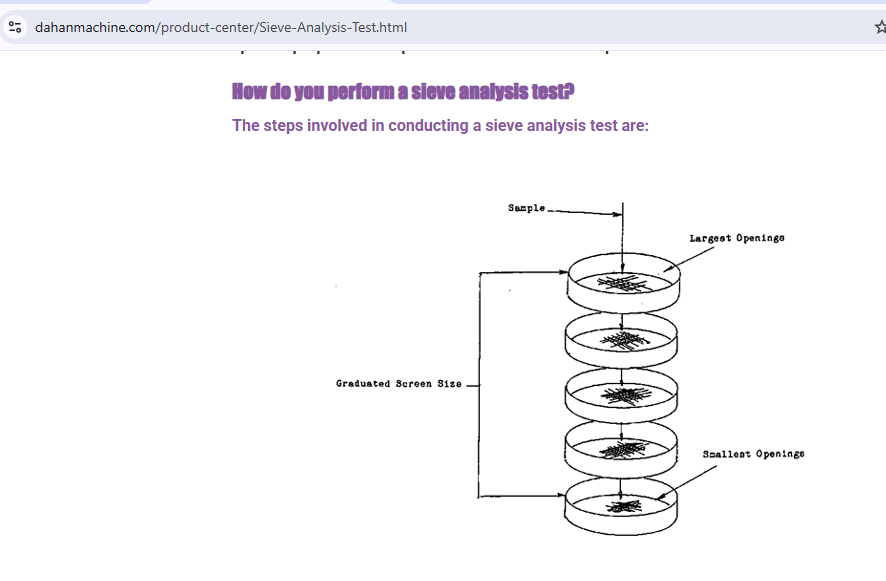
'Loosely speaking' because there would be infinite piles of those fine particles like on the bottom mesh in the pic (each pile in a different color and with infinite particles); before getting separated, all are mixed with each other in the most intricate way possible [each color pile touches infinite color piles including itself, the touching repeats multi-periodically (swapping neighbors infinite times), getting more and more mixed together!]. The mixed up colors are what manifest as chaotic/orderless/random when seen from top to bottom,ie {1,2,3,4...} in order. The proof shows how to separate them, and what gets revealed then - the orderly/precise mechanism that makes every number reach 1.
A ladder (or nest!) of concepts
Here are the various 'pieces' that constitute the proof... all 34 of them:
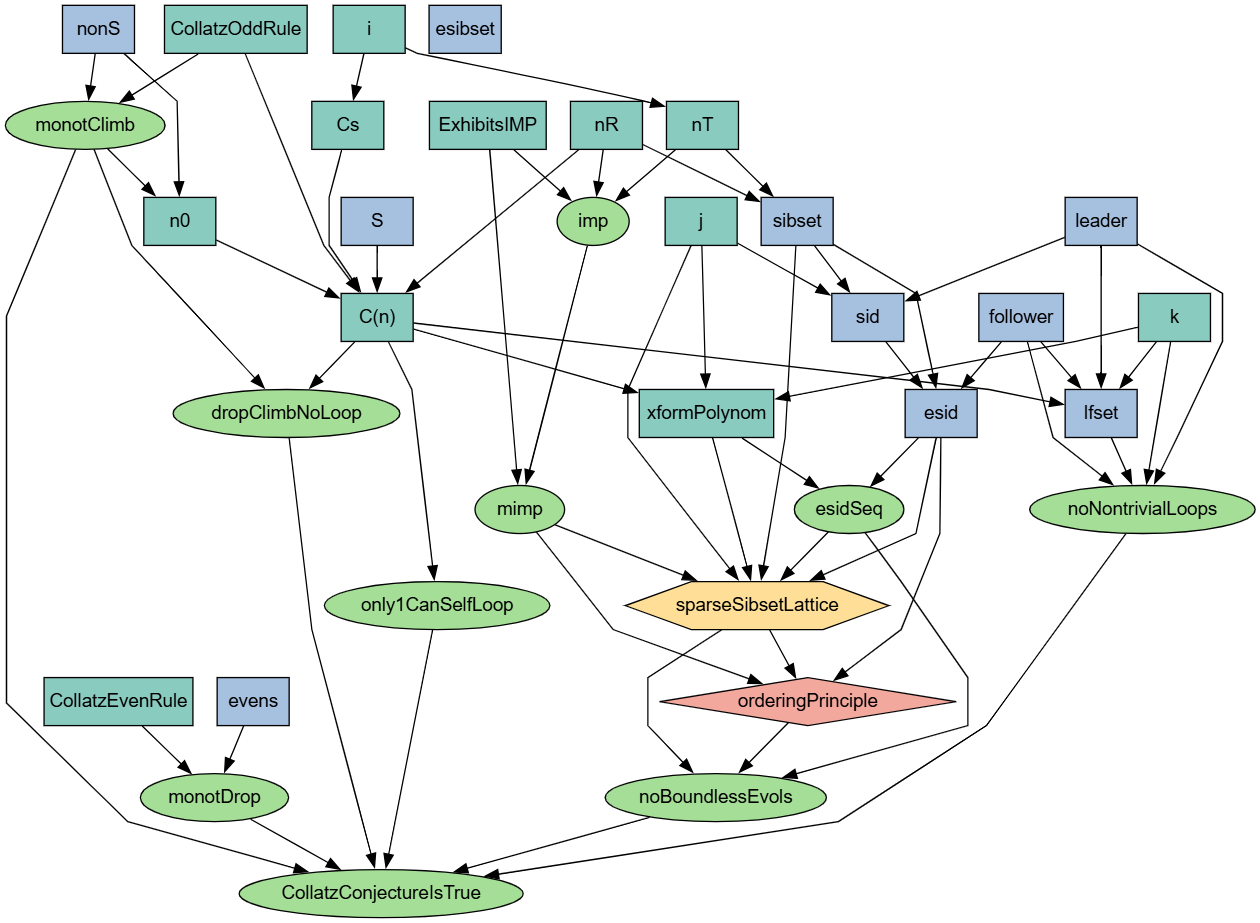
The pieces ('nodes') can be seen to feed into each other (except 'esibset', which is unused).
Here is the breakdown of the 34 nodes:
- 12 light teal rectangles: definitions [excluding set-related]
- 10 misty blue rectangles: set-related definitions
- 1 yellow orange hexagon: MSS structure [THE key!]
- 1 rouge diamond: property
- 10 light green ellipses: lemmas/theorems [including the conjecture we're proving!]
At the bottom, six arrows from theorems connect to 'CollatzConjectureIsTrue' - proving those six theorems would mean proving the conjecture :) the left three arrows relate to 'structural' items, the right two discount possibilities, the one in the middle proves the only possibility that remains (for how every number's sequence would end).
The slides that follow, will go over each of the 34 items [work-in-progress: just some notes about 'i' and 'MSS' are here, much more to come].
Partitioning of N+
Our proof involves subdividing the set of whole numbers (called N+) 1,2,3,4,5...inf, and 'solving Collatz' using just a subset:
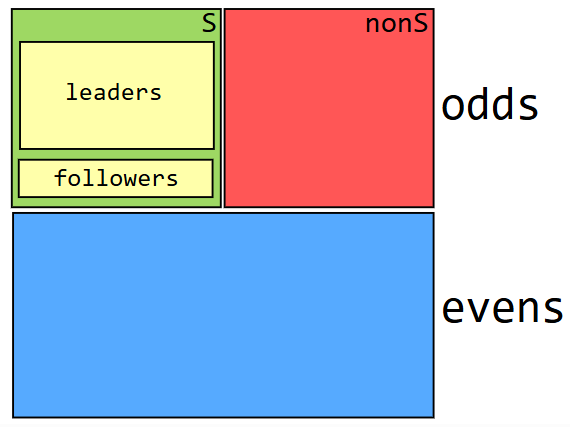
Specifically, we will use the subset which we call S [comprised of {1,5,9,13,17,21...inf}], which is itself comprised of 'leader' and 'follower' subsets. So our goal is to show that the Collatz sequences for the infinite numbers in S will all reach 1.
But what about the infinite numbers in nonS, and evens? We will show that they can be transformed into S equivalents, which is how/why we can safely ignore them - if all the numbers in S reach 1, it's guaranteed that ones in nonS and evens do as well. Of our 6 subgoals for the proof, three relate to this:
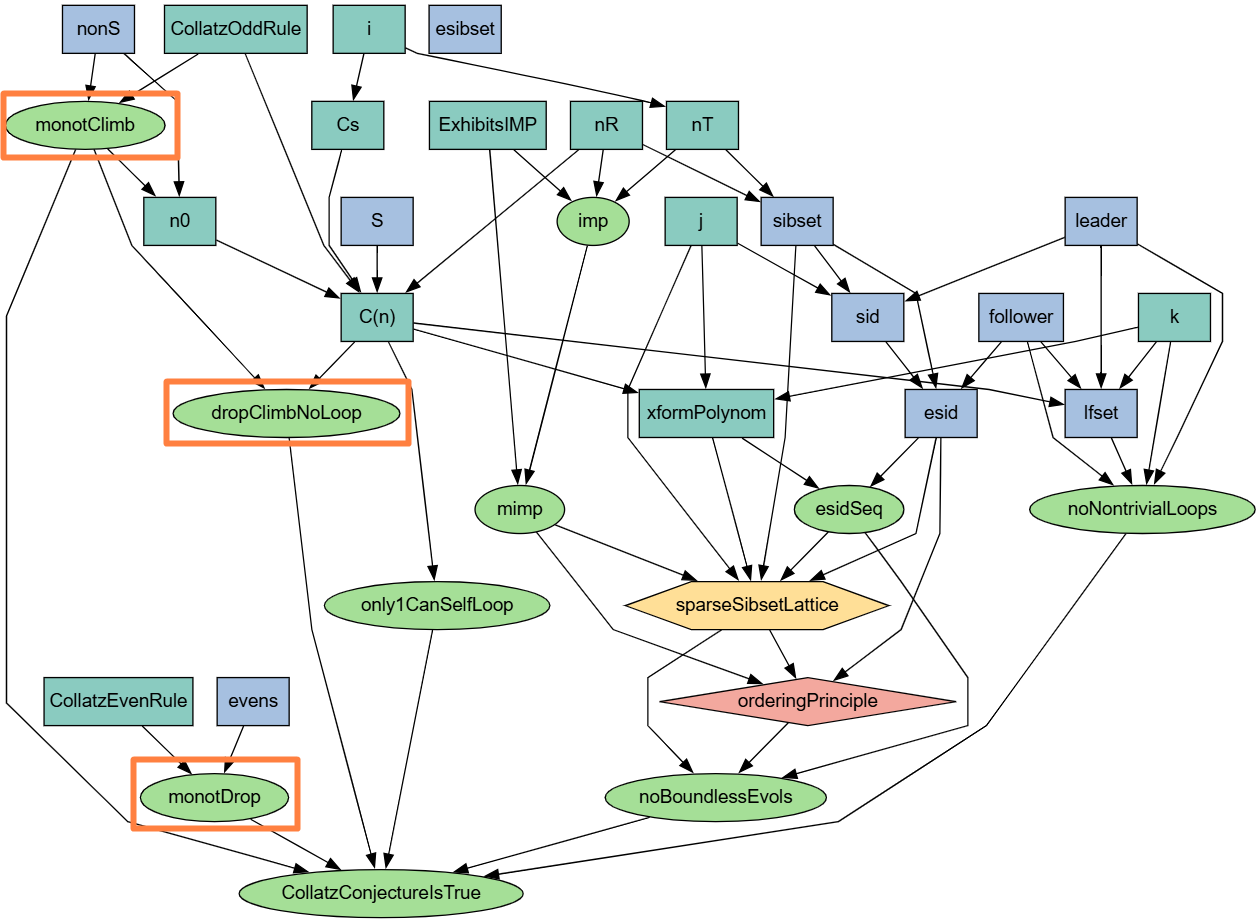
Why do it this way? Because it makes the analysis easier. Omitting evens is quite standard; what is novel is the S vs nonS partition and using just S.
Note that S contains 1, the Holy Grail of Collatz :)
'i'
Let's start with a basic but useful measure, called 'i' ('index') in the proof:
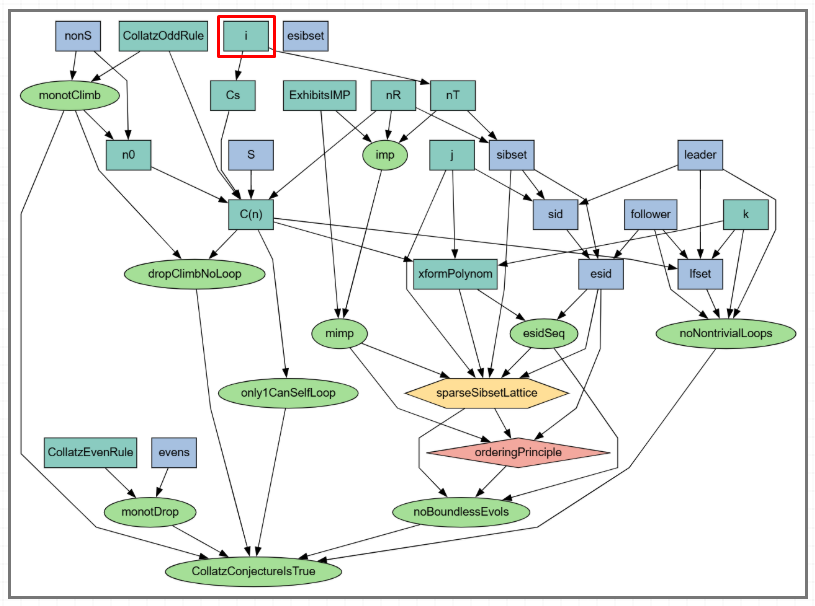
'i' lets us group (partition) the set of odd numbers {1,3,5,7,9...inf} into subsets, with a different gap (period) in each:
{1,5,9,13,17,21,25...} with period=4

{3,11,19,27,35,43...} with period=8

{7,23,39,55,71...}, period=16
...
How? Why?
Here's how:
 i = (n+1)/2 [given an odd number 'n']

 Eg:
 n  |  i
---------
 1  |  1
 21 |  11
 27 |  14
 7  |  4
 31 |  16
Why use 'i' to classify odd numbers into subsets like shown above? Because that will end up helping us to entirely omit half of them from our analysis! Eg. we won't need to prove that 7,23... will reach 1. Such omitting simplifies the overall analysis.
S
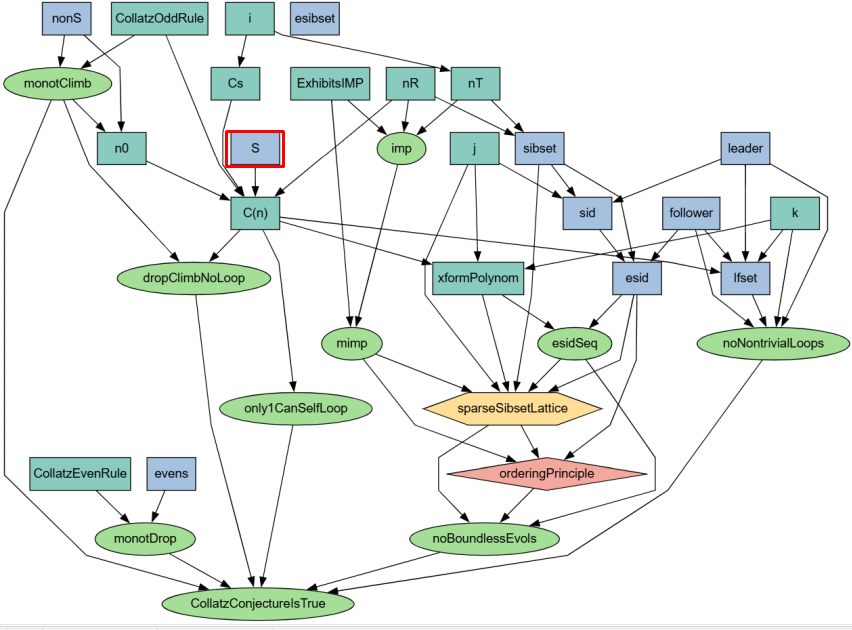
As mentioned earlier, S is simply defined to be the set of odd numbers {1,5,9,13...}.
nonS
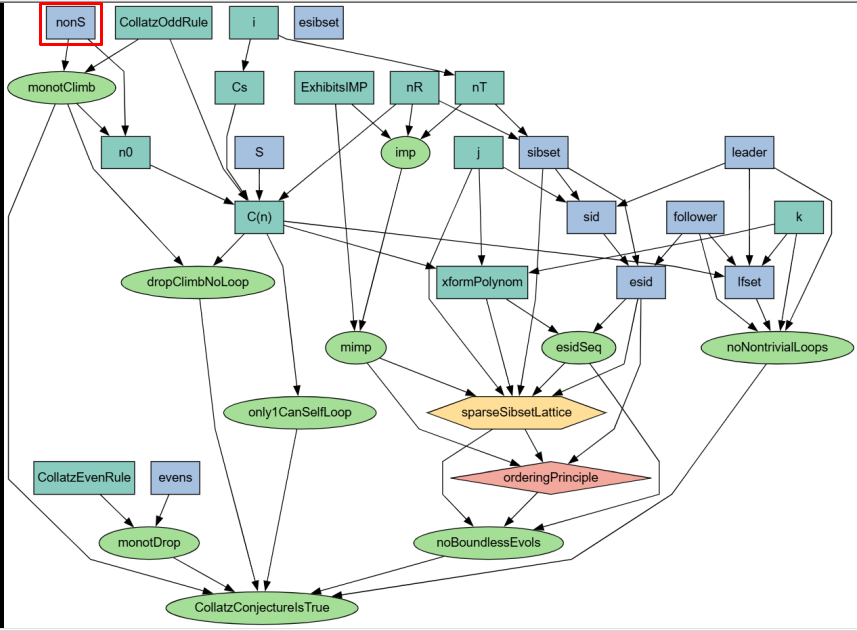
nonS complements S, and is comprised elements that are not {1,5,9,13}.
Eg. nonS includes {3,27,7,39,31...}.
Modular Sparse Sublattice (MSS)
Every number is S {1,5,9,13..} has an unique 'esid', which is a triplet (nR,nT',j). A sibset is a set of S elements with identical (nR,nT'), eg (1,0).
A number's trajectory, as it presumably heads to 1, is a sequence of esids. Eg:
  17    -> 13    -> 5
  1,0,1 -> 2,0,0 -> 3,0,0
The above sequence is a single row in the (1,0) sibset's elements' sequences. IOW:
 1     -> 1
 1,0,0 -> 1,0,0

 17    -> 13    -> 5...
 1,0,1 -> 2,0,0 -> 3,0,0

 33   -> 25...
 1,0,2...
 ...

 49   -> 37...
 1,0,3...
 ...
The sparse sublattice of 17's sequence would consist of infinite rows that all have the same sibset IDs of (1,0),(2,0),(3,0), but would differ in their 3rd ('j') element. This produces a rectangular lattice of triplets, with infinite height (due to infinite matching rows) and a finite width (number of columns - 3 in the example above if we create such a sublattice for 17->13->5).
In such a sublattice as the rows get deeper, the 'j' value down each column gets monotonically bigger (this simply follows from a sibset's organization).
As explained above, the sublattice does not refer to a sibset's elements in their original sequence - which are not sparse. Eg. for the sibset (1,0) whose elements are {1,17,33,49,65,81,97,113...}, the claim about stopping times isn't between those of 1,17,33,49,65... which are 1,3,6,5,4..., obviously not ordered. Instead, for ex., it's about 17, and its sparse echoes (rows further down), 33 and its sparse echoes, and so on (each such set of sparse echoes constitutes a separate sublattice):
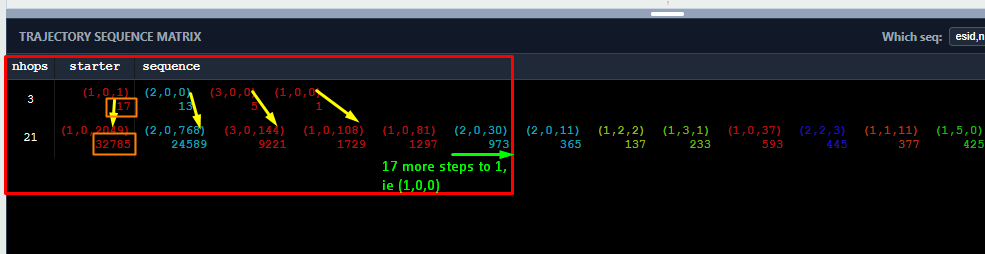
Similar to above (for 17) the sparse echoes of 33 will have matching sibset IDs [(1,0,j),(1,1,j),(2,1,j)...] with increasingly higher j values down the rows, and with increasingly ordered stopping times > 6. When 33 -> 1 it does so via 6 times, so the sublattice will have 6 columns. Here is 33's row:

The rectangular block structure shown above [with finite number of columns making up an esid triplet sequence, and infinite number of sparsed rows (all with matching/identical sibset IDs) resulting from a mod()ulus operation] is the Modular Sparse Sublattice, ie. MSS.