***
←
→
Assorted topics
Part 2 ["there's MORE!"]
|
The roundup continues...
We continue looking at even more 'cutting edge' technologies, and industry implementations - of retrieval, recommendations, knowledge extraction, etc.
This much is for sure - the field of 'IR' is one of the most RAPIDLY changing fields! Why? Because information is what runs society :)
External memory to enhance generic chat
The idea of using an LLM as a generic text engine (that has no deep 'domain knowledge) ALONG WITH 'external memory' [a custom 'DB' that contains content knowledge] is rapidly gaining ground!
https://towardsdatascience.com/use-chatgpt-to-query-your-neo4j-database-78680a05ec2 shows how ChatGPT can be used with Neo4j (a graph DB). The idea is this: rather than query Neo4j using its own 'Cypher' query language, we can use natural language instead.
https://tdoehmen.github.io/blog/2023/03/07/quackingduck.html shows to use chat to generate SQL!
RR - Rethinking with Retrieval (https://arxiv.org/pdf/2301.00303) solves reasoning-based tasks by using an external KB (knowledge base).
'Retrieval Transformer' is an approach that also uses external memory to keep the core LLM size DOWN [as low as 4%!!] of a regular LLM - https://jalammar.github.io/illustrated-retrieval-transformer/.
Autonomous task-achieving
Rather than carry on a back-and-forth conversation with an LLM to achieve a task, what if we could specify the task, and let the LLM AUTONOMOUSLY solve it, using sub-goals? This is classic 'agent-based' architecture, an elusive idea in AI thus far!
AutoGPT [eg. https://www.digitaltrends.com/computing/what-is-auto-gpt/] is a brand new approach that does this.
Another radical idea is use LLMs to simulate human behavior, giving rise to 'generative agents': https://arxiv.org/abs/2304.03442.
LLM+tasks+memory -> a 'computer' system!
Here is yet another idea: treat the LLM+tasks+DB as a 'computer' (analogous to processor+code+data)!
BabyAGI [eg. https://finance.yahoo.com/news/babyagi-taking-silicon-valley-storm-121500747.html] is such an attempt.
LangChain is a task programming language where we use specific commands in the form of 'templates', to compose our queries, and run() them, eg. https://www.pinecone.io/learn/langchain-intro. SudoLang is another such task-spec language.
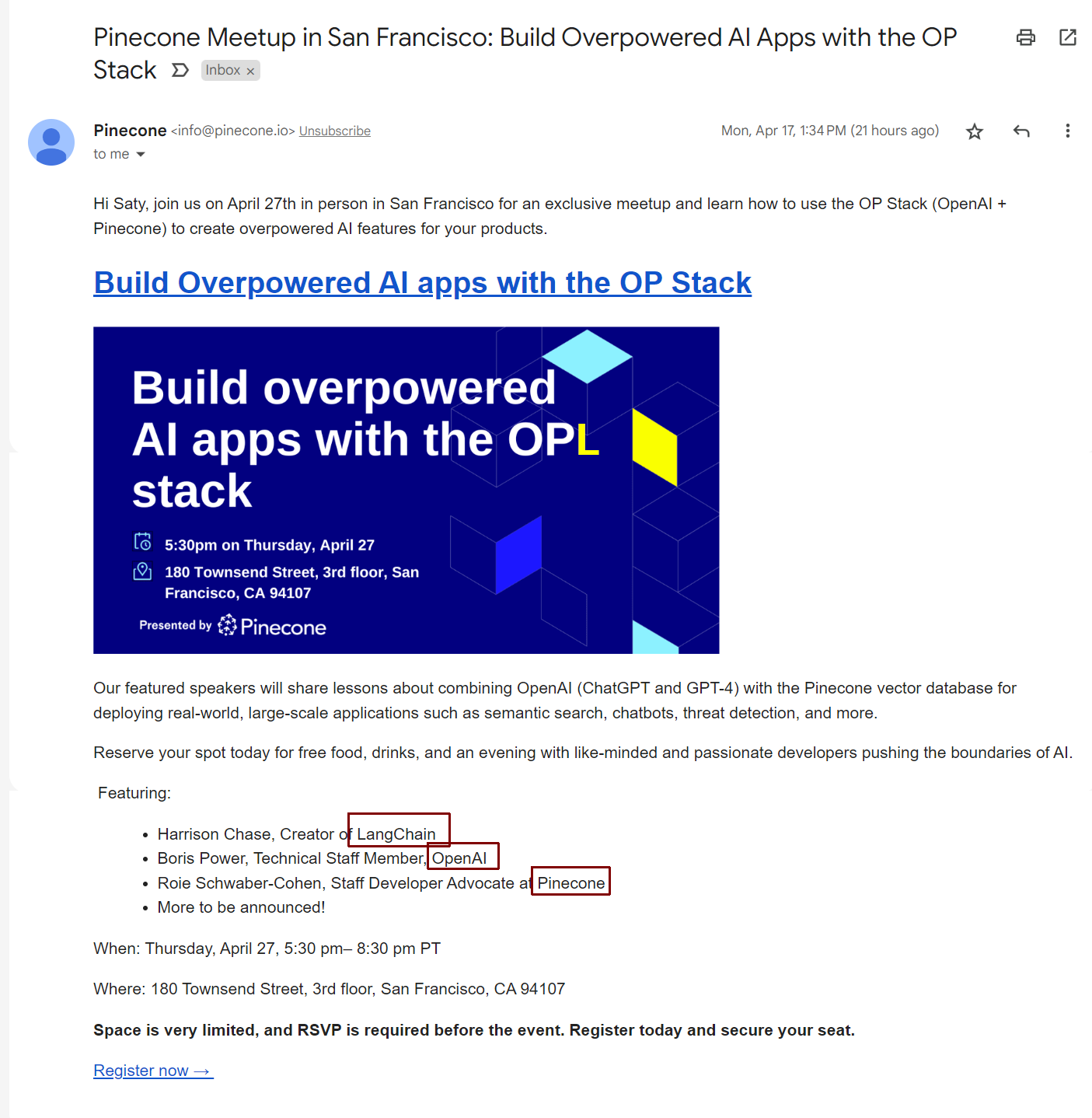
'OPL' is the name we could give to such a stack comprised of O(penAI)+P(inecone)+L(angChain), eg. https://towardsdatascience.com/building-llms-powered-apps-with-opl-stack-c1d31b17110f
Also :)
NER
'NER' (Named Entity Recognition) as you know, is a useful NLP information-related task - given text, or images, or video, or audio, what person/place/thing/... can we identify?
We can use BERT for NER, eg. via PyTorch.
Topic modeling
BERTopic is a topic-modeling technique based on BERT.
Here is a guide.
KG construction
Knowledge graphs (KGs) are an excellent form of knowledge representation, since they are well structured (eg via (s,p,o) triplets).
https://medium.com/@dallemang/llms-closing-the-kg-gap-29feee9fa52c shows how we can use ChatGPT to create KGs from plain (ie unstructured text).
Recommendation engines
REs are univerally useful, across multiple domains.
Monolith is TikTok's RE: https://analyticsindiamag.com/tiktok-parent-bytedance-reveals-its-sota-recommendation-engine/.
Twitter's RE:

Lyft's RE: https://eng.lyft.com/the-recommendation-system-at-lyft-67bc9dcc1793.
Clustering
We looked at K-means clustering. Here are others you can look up:
- t-SNE, eg. https://towardsdatascience.com/t-sne-clearly-explained-d84c537f53a
- HDBSCAN, eg. https://hdbscan.readthedocs.io/en/latest/how_hdbscan_works.html
- UMAP, eg. https://umap-learn.readthedocs.io/en/latest/clustering.html
Search
Here is an assortment of 'search' related items:
- this search looks for CC (Creative Commons) licensed content (images, audio)
- 'manifold search' uses manifold learning for similarity searches, eg. https://scikit-learn.org/stable/modules/manifold.html
- NN searches over a graph (rather than metric space): https://research.yandex.com/blog/graph-based-nearest-neighbor-search
- Redis-based AI-driven (vector) search: https://partee.io/notes/2022-9-13-SDSC-talk/
- Discord search (using inverted indexing): https://sukhadanand.medium.com/how-discord-indexes-billions-of-messages-f242e605e47c
NeRF, AR LBS
Standard LBS retrieves addresses, maps.
A new Google Maps update will retrieve immersive views, made possible by fusing together numerous distinct photos and aerial views, and seamlessly rendering them using NeRF [more here].